
Behaviour Breakdown
Guides
Behaviour can feel confusing — especially when you’re just starting out.
This section gently breaks down the “why” behind everyday behaviours, so you can understand what your dog is trying to tell you without feeling overwhelmed.
You’ll find simple explanations, easy-to-spot signs, and practical tips to help you build a calmer, more connected partnership with your dog.
Here, we look at behaviour through a kind, supportive lens — not blame, pressure, or outdated ideas. Your dog isn’t being dramatic. They’re communicating. And you’re learning how to listen.
This is your safe, beginner-friendly space to explore what’s really going on beneath the surface.
.png)
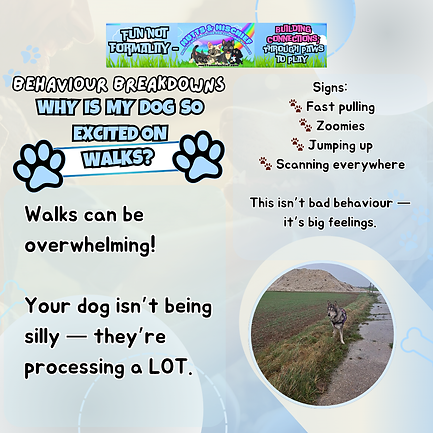
Overexcitement on Walks
Dogs often feel excited, overwhelmed, or overstimulated when they step outside. The world is full of scents, sounds, and movement, and beginners often mistake this excitement for “being naughty.”
Your dog isn’t being wild — they’re learning how to cope with a busy environment.
Simple Support Tips
✨ Let them sniff
✨ Use a longer lead
✨ Start walks in quieter areas
✨ Keep sessions short while they learn
Sudden Barking at Noises
They’re not being dramatic — they’re startled, unsure, or asking “Is there something I need to worry about?”
Sudden barking can feel surprising, especially if your dog seems calm one moment and alert the next. But for most dogs, barking at noises is a natural reaction — it’s simply how they communicate uncertainty.
Dogs have incredibly sensitive hearing. They pick up knocks, rustles, voices, footsteps, and distant sounds long before we do. When they bark, they’re not misbehaving — they’re trying to figure out what the sound means.
Your dog might bark because:
-
a noise startled them
-
they’re unsure if something is safe
-
they’re alerting you to something unusual
-
they’re feeling nervous or over-aware of their environment
-
their routine has changed and they feel more on edge
Barking into the air or at “nothing” doesn’t mean your dog is being silly — it means they heard something we didn’t. Barking after a loud noise is simply their way of recovering from the surprise.
What you can do:
✨ Stay calm and speak softly
Your reassurance teaches them the sound isn’t a threat.
✨ Acknowledge the sound
A simple “Thank you, I’ve got it” can help them settle.
✨ Reduce visual triggers
Closing blinds or curtains helps noises feel less alarming.
✨ Add gentle background sound
White noise, calming music, or a fan can soften sudden noises.
✨ Reward calm moments
If they look to you or settle quickly, praise or offer a treat — this builds confidence.
Sudden barking isn’t naughtiness — it’s communication.
Your dog is simply checking whether the world is still safe, and you can help them feel more secure every time it happens.
.png)
Why Won’t My Dog Eat Outside?
.png)
They’re too alert to eat. They may be feeling overwhelmed by the environment or worried about nearby triggers.
For many dogs—especially those still building confidence—eating outside can be surprisingly difficult. Food refusal isn’t a sign of being “awkward” or “fussy.” It’s usually a sign that your dog’s nervous system is too busy scanning the world to focus on food.
When a dog feels unsure, excited, overstimulated, or even a little fearful, their digestive system slows down. The brain is in “stay alert” mode, not “stop and eat” mode.
This can lead to:
-
🐾 Refusing food even if they love it at home
-
🐾 Spitting food out after taking it
-
🐾 Snatching treats because their body is tense
-
🐾 Sniffing food then looking away
-
🐾 Dropping treats without eating them
-
None of these are signs of being stubborn — they’re signs your dog doesn’t feel settled enough to eat.
Outside is full of smells, sounds, movement, and surprises. Your dog may be:
-
scanning for other dogs
-
watching for bikes or people
-
worried about loud noises
-
adjusting to a new environment
-
feeling sensory overload
-
focusing on staying safe
-
Eating requires a calm, regulated nervous system — and outdoors, that can be hard to achieve.
Support Tips
✨ Move to a quieter spot
Give your dog a moment to breathe and settle.
✨ Use higher-value treats
Think soft, smelly, easy-to-eat foods.
✨ Reduce pressure
Don’t push them to take food if they can’t — it adds stress.
✨ Offer distance from triggers
More space = more safety = better chance of eating.
✨ Try again later
Sometimes they just need time to regulate.
✨ Reward calm glances or check-ins
Even if they don’t eat, noticing you is a great sign.